

 Home
Home

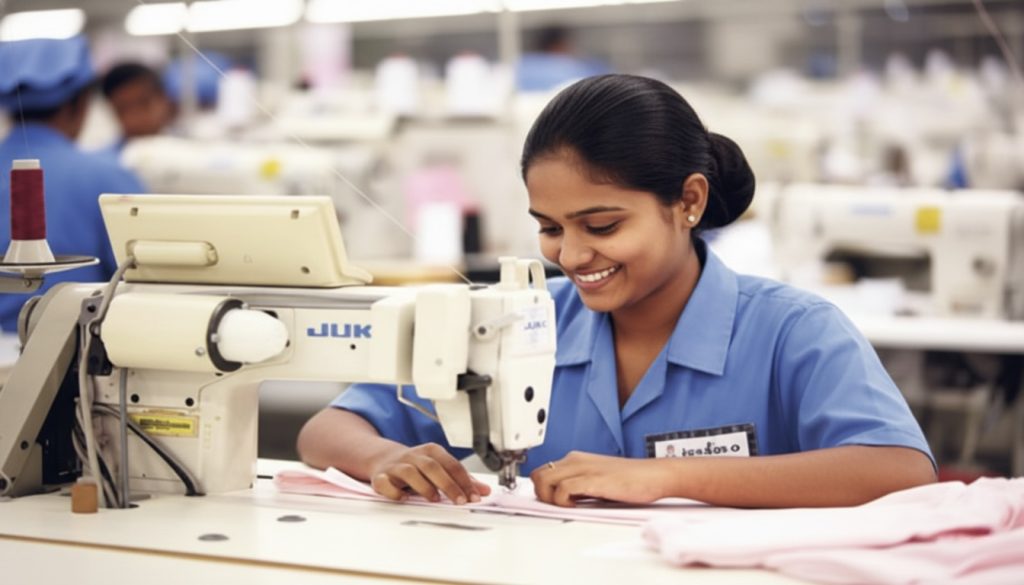
Why it is so difficult for HR to recruit Employees for Sewing Operation?
In the region of Asia, Sri Lanka plays a major role in the industry of textile and apparel providing quality garments to the UK, US and other countries in a reliable way of doing business compared to the other regional competitors such as India, Bangladesh and China etc. It has become one of the biggest industries in Sri Lanka and it makes the bigger portion of foreign exchange. Further, it employs more than 15% of the workforce of the country while making nearly 85% of total employees women. In addition to these direct job opportunities, there are many indirect job opportunities being open to the general public as a result of this industry.
Over the above said, it has been difficult to find the labour required to run the operations smoothly even though Sri Lanka , compared to other competitors in the region has a strong positive work environment for the industry in terms of labour regulations stipulated by the government. Further it is becoming more tightened with buyers’ influence for a better work environment.
Every data point, at its origin, is a footprint of human activity. It’s a purchase made, a song streamed, a step taken, a word searched. It’s a record of our hopes, our needs, our behaviors, and our challenges. Raw data is this potential in its dormant, chaotic state; a symphony of human experience waiting for a conductor.
But Still HR Department pay much attention to the recruitment of employees especially to the operation. Why is that? So do we do to overcome this issue?
When we move beyond mere analysis into amplification, our role transforms. We are no longer just technicians; we are translators and enablers. We use these tools to listen to the story the data is trying to tell which is a story about how we can live healthier, work smarter, and connect more deeply.
- HR and Production department are keen on absenteeism and LTO. Strictly monitor the rates and even those have become first prioritised KPIs.
- Recruitment campaigns are organised in order to attract people to the factories.
- Home visits are arranged on regular basis for consecutive absentees since it is believed to be potential LTO
- More benefits given to machine operators compared to the other supportive service providers.
- Hostels are provided for sewing associates from remote areas.
- If somebody is introducing a sewing associate, a cash reward is given at factory level.
- In any factory, vacancies for sewing associates are available at any given time but not for others
Simple Practices and words being used will be created the perception for the society to look at it.
What and how we do something for a longer period of time, we simply tell our minds that it is the best way of doing things and then it will become the norm. It will become the culture for the time being. Similarly, how the industry is running have created the culture of the industry. The practices and the words being used in the factory environment have become the norms of identifying the industry.
Further in our day-to-day life, there are some common industry specific words being used such as “Lamai” referred to Sewing associates that is being used inside the factory as well. For instance, a supervisor may say “ Ada Lamayi Thun denek Ne” (“Three sewing associates are absent today”).
If somebody asked me about my job, I would reply first with “At So and So Garment Manufacturing Company” then his second definite question is that “Mahanawada?” (“Sewing or what?”). Then I might say, “ No..No.. am a Production Assistant..or an HR Assistant”.
Why I try to emphasise that I am not attached to sewing department but HR or something. Simply because if it is sewing, the perception may differ. The social status at present for the sewing associates are not that good. There are some terms in the colloquial language which determines and changes the perception of general public. Few of them are “Mahanawa ” (Sewing operation), “Garment Kello” (Females working in Garment Factories), “Garment Eka” (It substitutes the meaning of Garment Factory though exact translation is “a garment”).
At the end of a hard day at the factory, they share what happened on that particular day. The more they speak positively about the factory, the more positive the perception that is being created and vice versa. The information flow of words of mouth which is supported by real experience in the shop floor is a strong way of spreading what was happening in the factory/in a garment factory. The words used in the shop floor/factory, the practices and behaviours are really very important in this context. All these are communicated by word of mouth; a strong way of communication. The general public then would assess the whole industry and they create some sort of perception towards the industry and behave accordingly.
Couple of years back, I saw a particular newspaper article with the heading “Katunayaka Kirilliyo” ( The meaning is probably the free lady birds at Katunayaka EPZ) and shocked. Not even the people work in the same industry, others as well try to influence the bad of it.
So what we have created has back fired making more and more troublesome to run the operations.